
So you're thinking about buying your first e-bike. Brilliant decision — but if you've started looking, you've probably also discovered it's a bit of a rabbit hole. Hub motor or mid-drive? Torque sensor or cadence? What's a Watt-hour? Do you need a licence? How much should you actually spend?
Take a breath. This guide walks you through everything, in plain English, in the order you actually need it. By the end, you'll know exactly what to look for, what to ignore, and how to choose the right e-bike for your life — with confidence and no regrets.
No jargon dumps, no pressure. Just the honest, practical advice we'd give a friend.
Table of Contents
- First, Why an E-Bike?
- Step 1: Figure Out How You'll Actually Ride
- Step 2: Choose Your Type of E-Bike
- Step 3: Understand the Specs That Matter
- Step 4: Set a Realistic Budget
- Step 5: Know the UK Law
- Step 6: Don't Forget the Essentials
- The Golden Rules for First-Time Buyers
- FAQs
First, Why an E-Bike?
If you're on the fence, it's worth remembering what an e-bike actually gives you. It's not "cheating" — it's a genuinely different way to get around.
An e-bike flattens hills, shrinks distances, and means you arrive without being a sweaty mess. It turns a commute you'd never cycle into one you look forward to. It replaces car journeys (and their costs), gets you moving without feeling like exercise, and — for a lot of people — quietly becomes the most-used thing they own. You still pedal; the motor just makes everything easier.
Now let's find the right one for you.
Step 1: Figure Out How You'll Actually Ride
This is the most important step, and the one most people skip. Before looking at a single bike, answer these honestly:
- What's the main journey? Commuting, leisure, the school run, replacing a car, weekend adventures?
- How far? Your longest regular ride matters more than your average one.
- What's the terrain? Flat city streets, big hills, gravel, mud?
- Where will you store it? A garage, a flat hallway, a shed, a car boot?
- Will you carry it? Up stairs, onto trains, into a car?
- Carrying anything (or anyone)? Kids, shopping, work kit?
Your answers point straight to the right type of bike. A hilly commute where you carry the bike up to a flat is a completely different bike from a flat leisure ride you store in a garage. Nail this first, and every other decision gets easier.
Step 2: Choose Your Type of E-Bike
E-bikes come in a few broad families. Here's which suits whom.
Folding e-bikes — fold down for storage and transport. Ideal for small flats, mixed bike-and-train commutes, caravans, and car boots. Increasingly essential in cities, since non-folding e-bikes are now banned on much of London's rail network. Great for: commuters, city dwellers, travellers.
City & commuter bikes — comfortable, upright, practical, often with racks and lights. Built for the daily grind. Great for: everyday commuting and errands.
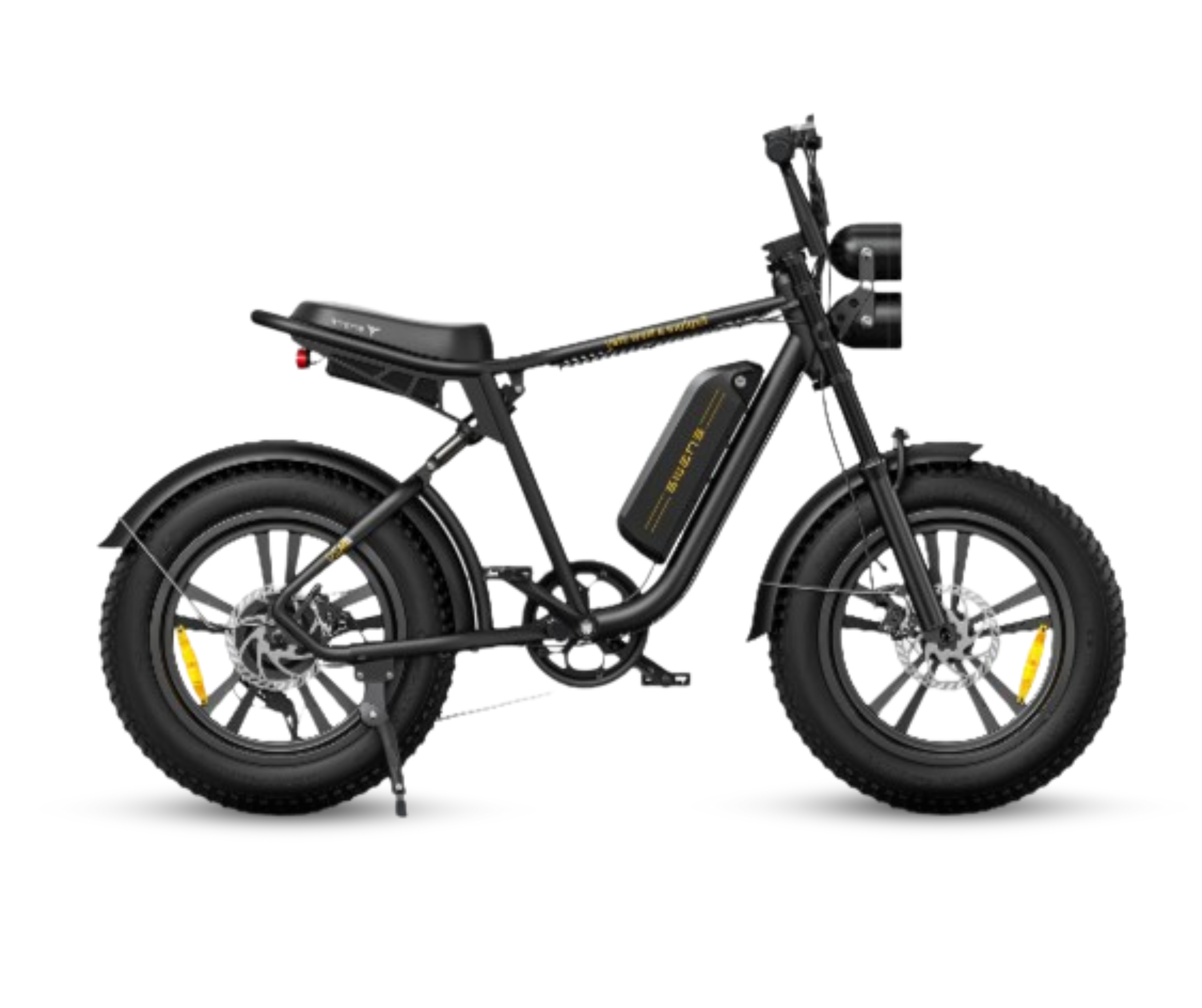
Fat-tyre & all-terrain — chunky tyres for grip, comfort, and going off-road. Rugged and stable. Great for: rough roads, trails, comfort-seekers, bigger riders.
Cargo & family bikes — built to carry kids and loads, sometimes replacing a car entirely. Great for: families and car-replacers.
Lightweight & carbon — the lightest bikes, easiest to carry and nippy to ride. Great for: those who lift their bike often or want a premium feel.
Not sure which format fits? Our brand comparison guides break down real models by use case — or just ask us.
Step 3: Understand the Specs That Matter
Spec sheets look intimidating, but only a handful of things genuinely matter. Here's the plain-English version (and our full Jargon Buster goes deeper on all of them).
Motor: hub vs mid-drive. A hub motor (in the wheel) is smooth, quiet, affordable, and great for flat-to-rolling terrain. A mid-drive (at the pedals) climbs hills far better and feels more natural, but costs more. Hilly area? Lean mid-drive. Mostly flat? A hub motor is perfect and better value.
Torque (Nm) — the "punch." This tells you how strongly the bike pulls away and climbs. Around 40–45 Nm is fine for flat terrain; 50–65 Nm is a confident all-rounder; 75–100 Nm is serious hill-flattening power. Don't obsess over Watts — UK road-legal bikes are all capped at 250W, so torque is what you actually feel.
Sensor: torque vs cadence. This is the single biggest factor in how a bike feels. A torque sensor matches power to how hard you pedal — smooth and natural. A cadence sensor just detects pedalling and can feel like an on/off switch. If ride quality matters to you, prioritise a torque sensor.
Battery: look at Watt-hours (Wh). This is the truest measure of range (Volts × Amp-hours). More Wh = more range. And be realistic: advertised range is a best case — expect roughly 60–70% in real riding, less in hills, cold, or on high assist. If you need 40km of real range, buy a bike rated for 60km+.
Brakes. Hydraulic disc brakes are stronger, smoother, and better in the wet than mechanical ones — worth having, especially on heavier or faster bikes.
Belt vs chain. A carbon belt drive means no oil, no rust, near-zero maintenance — lovely for daily riders. A chain is cheaper and repairable anywhere, but needs upkeep.
Step 4: Set a Realistic Budget
Here's the honest truth every first-time buyer needs to hear: the cheapest e-bike is almost never the best value. Rock-bottom bikes cut the things that matter most — torque sensors, hydraulic brakes, decent batteries — leaving you with a jerky ride, poor range, and a bike you'll want to replace.
A rough guide to what your money buys (and our budget-tier guide goes model-by-model):
- ~£800 — a genuinely good, no-compromise first e-bike (torque sensor, hydraulic brakes, real range).
- ~£1,200 — the sweet spot where quality, comfort, and touring capability really open up.
- ~£1,600 — premium tech: auto-shifting, belt drives, smart features, effortless riding.
- ~£2,000+ — serious capability, including cargo bikes that can replace a car.
The smart move isn't the lowest price — it's the bike that gives you the most genuine quality for your money, matched to how you ride. Spend a little more than rock-bottom, and you'll enjoy every ride for years.
Step 5: Know the UK Law
Good news: legal e-bikes need no licence, no tax, no insurance, and no registration. To qualify as a road-legal EAPC (Electrically Assisted Pedal Cycle), a bike must meet all three of these:
- Motor no more than 250W
- Assistance cuts off at 15.5 mph (25 km/h)
- No throttle that drives it above 6 km/h without pedalling
You also need to be at least 14 years old to ride one on public roads. Anything more powerful or faster (some "moped-style" or off-road bikes) is legally a motor vehicle, needing registration, licensing, and insurance — so always check what you're buying. Our full UK E-Bike Law Guide explains it all, and everything we sell as a road bike is the fully-legal 250W version.
Step 6: Don't Forget the Essentials
Budget a little beyond the bike itself for the things that make ownership safe and enjoyable:
- A good lock — e-bikes are valuable; security matters. See our security guide.
- A helmet — not legally required, but always sensible.
- Lights — essential for safe riding (and often built in).
- A phone mount, mudguards, and a rack if they suit your riding.
Our essential accessories guide covers what's genuinely worth buying and what isn't — so you don't overspend on kit you'll never use.
And once your bike arrives, a little care keeps it running for years — our maintenance guide makes it easy.
The Golden Rules for First-Time Buyers
If you remember nothing else, remember these:
- Match the bike to your life, not to a spec sheet or a sale price.
- Torque (Nm) and Watt-hours (Wh) matter more than Watts — they're what you feel and how far you go.
- A torque sensor and hydraulic brakes are the marks of a genuinely good bike.
- The cheapest bike is rarely the best value — buy the smartest, not the cheapest.
- Halve the advertised range in your head to set realistic expectations.
- Test-ride before you buy — nothing beats feeling a bike for yourself.
- Buy from a proper retailer — authorised, UK-legal stock, real warranty, real support.
Frequently Asked Questions
How much should I spend on my first e-bike?
Around £800 gets a genuinely good, no-compromise first e-bike. The sweet spot for quality and capability is often £1,000–£1,600. Avoid the very cheapest models, which cut corners you'll regret. Spend to match how you'll actually ride.
Do I need a licence or insurance for an e-bike?
No — as long as it's a road-legal EAPC (250W, 15.5 mph assist limit, no full-speed throttle), you need no licence, tax, insurance, or registration. You must be at least 14 to ride one on public roads.
How far will an e-bike really go on a charge?
Expect roughly 60–70% of the advertised figure in real-world riding — less in hills, cold weather, or on high assist. If you need 40km of real range, choose a bike rated for 60km or more.
Hub motor or mid-drive — which should I choose?
Hub motors are smooth, quiet, and great value for flat-to-rolling terrain. Mid-drives climb hills much better and feel more natural, at a higher price. Hilly area or want the best ride feel? Mid-drive. Mostly flat and budget-conscious? Hub motor.
What's the most important spec to look at?
For ride feel, a torque sensor. For power, torque (Nm). For range, Watt-hours (Wh). Don't fixate on Watts — road-legal bikes are all 250W.
Should I buy online or in a shop?
Ideally, test-ride in a shop before buying — feeling a bike is the best way to choose. At Uni-trax you can test-ride at our UK stores, then buy with full UK warranty and support either way.
Can an e-bike replace my car?
For many people, yes — especially with a cargo or family model for the school run and shopping. See our e-bike vs car cost guide to see the savings.
The Takeaway: Buy With Confidence
Choosing your first e-bike comes down to one thing: understanding how you'll ride, then matching the bike to it. Get that right, focus on the specs that genuinely matter, spend smart rather than cheap, and you'll end up with a bike you love — one that quietly becomes the most useful thing you own.
And you don't have to work it out alone. That's exactly what we're here for.
▶ Browse all e-bikes at Uni-trax · Find your nearest store for a free test ride.
Not sure where to start? Message us on Instagram or Facebook — tell us how you'll ride, and we'll point you to the perfect first e-bike. No pressure, no jargon, just honest advice.
▶ Subscribe to the newsletter for 10% off your entire order.
Article keywords
first e-bike buyer's guide how to choose an electric bike best e-bike for beginners UK e-bike buying guide 2026 what to look for in an e-bike hub vs mid-drive e-bike specs explained first time e-bike buyer Uni-trax e-bike guide