
Here's a thought experiment I've been enjoying.
Imagine two friends setting off from the northern edge of London on a bright Saturday, heading out through Hertfordshire towards Cambridge. Quiet lanes, the occasional village green, a pub stop somewhere around the halfway mark. Maybe 60km if you're sensible, more if you're not.
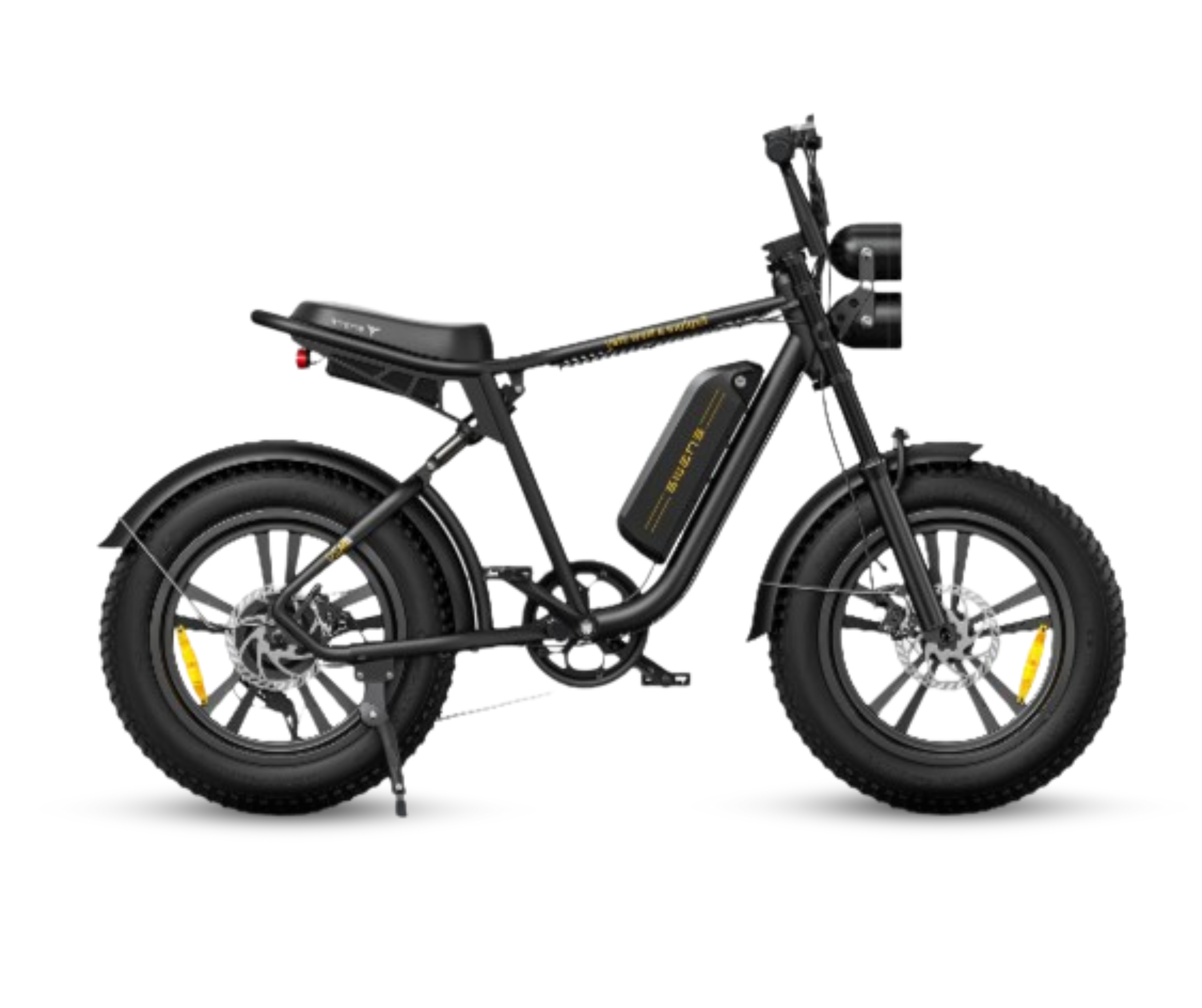
One rides my ENGWE O20 Boost. The other rides a Fiido T3 — the new compact family cargo bike.
On paper that's an odd pairing, and that's exactly why it's interesting. These bikes were designed for completely different lives. Put them on the same road for a day and their differences stop being spec-sheet abstractions and start being things you'd actually feel.
I'll be honest: before I looked properly at the numbers, I assumed this would be a comfortable win for my folder. It isn't. Let's ride it, hypothetically, and see what actually happens.
The Two Bikes
ENGWE O20 Boost — £1,099. A folding commuter with ambitions: 250W hub motor pushed to 75 N·m with a Boost function, a 720Wh LG battery claiming up to 140km, hydraulic front fork with 50mm travel and lockout, dual-piston hydraulic discs with 160mm rotors, Shimano Altus 8-speed, 20" × 2.125" anti-puncture tyres, 40 lux K-Mark lights, a rear rack rated to 15kg, and a hidden Find My-compatible tracker. Around 26.5kg. It folds.
Fiido T3 — £1,727. A compact short-tail cargo bike built around a 250W Mivice mid-drive motor delivering 100 N·m, with a torque sensor, a 972Wh removable battery good for up to 120km, a 150kg payload, 70mm oil-damped coil suspension fork, four-piston HDM-5 hydraulic disc brakes, CST 20" × 2.4" tyres, NFC unlocking with a built-in horseshoe lock, integrated LED lighting, and a low-step adjustable frame. 33kg. It doesn't fold.
One is a folder that punches above its weight. The other is a load-carrier with genuinely serious componentry. Let's see who copes better.
The First Hour: Getting Out of Town
The first stretch is the least romantic part of any ride out of London — suburban roads, traffic lights, roundabouts, the slow negotiation towards actual countryside.
This is where the T3 quietly shines. Cargo bikes are built for exactly this: stop-start streets, low speeds, tight turns, and the confidence to sit upright in traffic. The mid-drive delivers power through the gears, which means smooth, controlled pull-away from every junction, and the torque sensor adjusts in real time to how hard you're pushing. The low-step frame makes every set of lights easier. It feels planted and unhurried.
The O20 Boost is friskier. With 75 N·m and a Boost button, it leaps away from lights in a way that's genuinely fun and occasionally slightly silly. On this section, the Boost bike is the one grinning; the T3 is the one arriving calm.
Early verdict: honours even, different temperaments.
The Hills of Hertfordshire
Once you're north of the M25, the ground starts to roll. Nothing alpine, but enough short, sharp rises to sort the bikes out.
And here's where my assumption fell apart. I expected the O20 Boost's 75 N·m to settle this. But the T3 has 100 N·m — and it's a mid-drive, which means it sends power through the chain and gears and can use the bike's gearing to multiply torque on a climb. That's the reason mid-drives have their reputation for hill-climbing: they work with the drivetrain rather than independently of it.
So on the climbs, the T3 is genuinely the stronger bike. More torque, delivered more effectively. The O20 Boost is no slouch — 75 N·m from a hub motor is more than many premium systems offer in this class, and the Boost function gives you a surge exactly when you need it — but if the road tilts up sharply, the cargo bike walks away.
The honest counterpoint: the T3 is also carrying 33kg of its own weight versus the O20 Boost's 26.5kg. Unloaded, that eats into the advantage. Loaded with two kids and the shopping, the mid-drive's superiority becomes overwhelming — which is, of course, exactly the job it was built for.
Verdict: T3, on the climbs.
The Long Flat Middle
Miles of quiet lanes, hedgerows, the occasional tractor. This is the bit you came for.
This is the O20 Boost's territory. It's nearly 7kg lighter, which tells over distance. Twenty-inch wheels aren't the fastest-rolling things on earth, but with a big battery you can sit comfortably at the assist limit for hours, and the hydraulic fork takes the edge off rough country tarmac. The anti-puncture tyres earn their keep on lanes strewn with flint and hedge trimmings.
The T3 is working harder here — not because it's incapable, but because it's a 33kg bike with cargo geometry, optimised for stability under load rather than efficiency over distance. It'll do it comfortably. It just isn't what it was drawn for. Its 2.4" tyres are more comfortable but slower-rolling than the O20's 2.125".
Verdict: the folder takes this one, mostly on weight.
The Pub Stop (and the Luggage Question)
Halfway to Cambridge, you stop. And whoever's carrying the picnic, the spare layers, the locks, the flask, and the inevitable impulse purchase from a village farm shop is going to have opinions about their bike.
The T3 wins this comprehensively, and it isn't close. A 150kg payload with room for up to two children on the reinforced rear deck, plus compatibility with child seats, guardrails, baskets and trailers. Carrying things is its entire purpose.
The O20 Boost carries what it can. The rear rack is rated to 15kg, which is genuinely useful — a pannier with clothes, lunch, and a lock is well within that. But there's a limit, and the T3 laughs at it.
Verdict: T3, emphatically. If your day involves carrying more than a light pannier's worth, the comparison ends here.
The Battery Maths
Sixty kilometres out. Sixty back, if you're ambitious. This is where battery capacity stops being a spec and starts being peace of mind.
This is the other place my assumptions were wrong. The T3's 972Wh battery is substantially bigger than the O20 Boost's 720Wh — and it's removable, and cross-compatible with the T3 Max dual-battery system, so it can double as a spare if you run two bikes in the family.
On claimed range the O20 Boost still edges it (up to 140km versus up to 120km), which makes sense — it's a lighter bike with a smaller motor. Realistically, reviewers find 90–110km from the O20 Boost in mixed riding.
The practical upshot: on a 60km day, both bikes finish comfortably with reserve. Neither rider spends the afternoon doing anxious mental arithmetic. That's a genuine win for both — and a reminder that "long range" matters less than "enough range for the ride you actually do."
Verdict: honours even, for different reasons.
Braking and Comfort
Worth a quick word, because the T3 is better equipped than I expected here too.
Brakes: the T3 runs four-piston HDM-5 hydraulic discs; the O20 Boost has dual-piston hydraulics with 160mm rotors. Both are strong and reliable in the wet, but four-piston is more braking power — which makes sense on a bike designed to stop safely with 150kg aboard.
Suspension: the T3 has 70mm of oil-damped coil travel; the O20 Boost has 50mm hydraulic with adjustable lockout. The T3 is plusher; the O20 Boost's lockout is handy when you want efficiency on smooth tarmac.
Verdict: T3 on outright capability, O20 Boost on adjustability.
Getting Home
Assume, realistically, that somebody's legs have had enough by Cambridge and the sensible move is the train home.
And here the O20 Boost has its trump card: it folds. Folded, it's a bike you can take on trains where non-folding e-bikes are banned — which, as we've covered before, increasingly matters in and around London. At 26.5kg it's not a featherweight, but the fold is the thing that gets you home.
The T3 doesn't have that option, and at 33kg it's not something you're lifting onto a train regardless. A train-assisted return needs planning around operator rules for full-size bikes.
Verdict: the O20 Boost, decisively, on flexibility.
So Which Bike Won?
Neither — but not for the reason I expected when I started this.
I went in assuming the folder would dominate a long countryside day and the cargo bike would struggle along behind. The real numbers say otherwise: the T3 has more torque, a bigger battery, stronger brakes, and more suspension travel. On pure capability, it's the more serious machine.
What the O20 Boost has is different: it's 7kg lighter, it folds, and it costs £628 less. On this particular day, those three things matter a lot — the weight over distance, the fold for the train home, and the price for a bike that isn't carrying a family.
The truthful summary:
- "How do I get around, go far, store it in a small flat, and take it on the train?" → O20 Boost (£1,099).
- "How do I carry my children and my life without a car — and climb hills while doing it?" → Fiido T3 (£1,727).
These bikes aren't really competitors. They're answers to different questions, and both answer theirs extremely well. If you're choosing between them, you probably already know which question is yours.
And if you don't — come and try both.
▶ See the ENGWE O20 Boost — £1,099 · See the Fiido T3 — £1,727 · Find your nearest store
(The T3 is currently available to pre-order, shipping in 8–10 weeks — here's why pre-ordering is worth it.)
Head to Head: The Numbers
| ENGWE O20 Boost | Fiido T3 | |
|---|---|---|
| Price | £1,099 | £1,727 |
| Motor | 250W hub, 75 N·m + Boost | 250W Mivice mid-drive, 100 N·m |
| Battery | 720Wh LG | 972Wh removable |
| Claimed range | Up to 140km (real ~90–110km) | Up to 120km |
| Weight | 26.5kg | 33kg |
| Payload | 15kg rack | 150kg (up to 2 children) |
| Brakes | Dual-piston hydraulic, 160mm | Four-piston hydraulic |
| Suspension | 50mm hydraulic, lockout | 70mm oil-damped coil |
| Tyres | 20" × 2.125" anti-puncture | 20" × 2.4" CST |
| Security | Hidden Find My tracker | NFC unlock + horseshoe lock |
| Folds? | Yes | No |
Both are UK-legal 250W EAPCs with a 15.5mph assist limit — no licence, tax, or insurance needed.
Frequently Asked Questions
Is the ENGWE O20 Boost good for long rides?
Yes — its 720Wh LG battery (90–110km real-world), 75 N·m motor, and 50mm hydraulic fork make it genuinely capable over distance, despite being a folder. Its light weight relative to a cargo bike helps too.
Is the Fiido T3 suitable for countryside rides?
More than I expected. With 100 N·m, a 972Wh battery, four-piston brakes and 70mm of suspension, it's a seriously capable bike. At 33kg it's working harder over long flat distances than a lighter machine, but it'll complete a big day comfortably.
Mid-drive or hub motor — which is better for hills?
Mid-drives generally climb better because they deliver power through the gears, multiplying torque — especially under load. The T3's 100 N·m mid-drive beats the O20 Boost's 75 N·m hub motor on a climb, though the O20 Boost is lighter, which claws some of that back.
Which has the bigger battery?
The Fiido T3, at 972Wh versus the O20 Boost's 720Wh. The O20 Boost still claims slightly more range (140km vs 120km) because it's a lighter bike with a smaller motor.
Which is better value?
They're priced for different jobs — £1,099 versus £1,727. If you need to carry children and cargo, the T3 is excellent value for what it does. If you need range, folding, and a lower price, the O20 Boost is hard to beat.
Can I take either on the train?
The O20 Boost folds, so it's permitted where non-folding e-bikes are banned — including much of the TfL network. The T3 doesn't fold and weighs 33kg, so check your operator's rules for full-size bikes.
Which would you recommend for a family?
The Fiido T3, without hesitation. A 150kg payload, room for two children, and child seat and trailer compatibility make it purpose-built for a job the O20 Boost simply isn't designed for.
The Takeaway
Spec sheets tell you what a bike has. Imagining it on a real road tells you what a bike is for — and it's worth doing honestly, because I started this expecting one answer and the numbers gave me another.
Put the O20 Boost and the Fiido T3 on the lanes to Cambridge and you learn something useful: one is a light, foldable all-rounder that fits in your hallway and comes home on the train, and the other is a genuinely powerful car replacement that happens to be compact. Both excellent. Neither trying to be the other.
Work out which day you're actually planning, and the choice makes itself.
▶ Explore our full range · Find your nearest store for a test ride.
Got a route you'd put these two on? Tell me on Instagram — I'm always after suggestions.
▶ Subscribe to the newsletter for 10% off your entire order.
Keywords: ENGWE O20 Boost vs Fiido T3 folding e-bike vs cargo bike mid-drive vs hub motor London to Cambridge cycling best e-bike for long rides family cargo e-bike UK