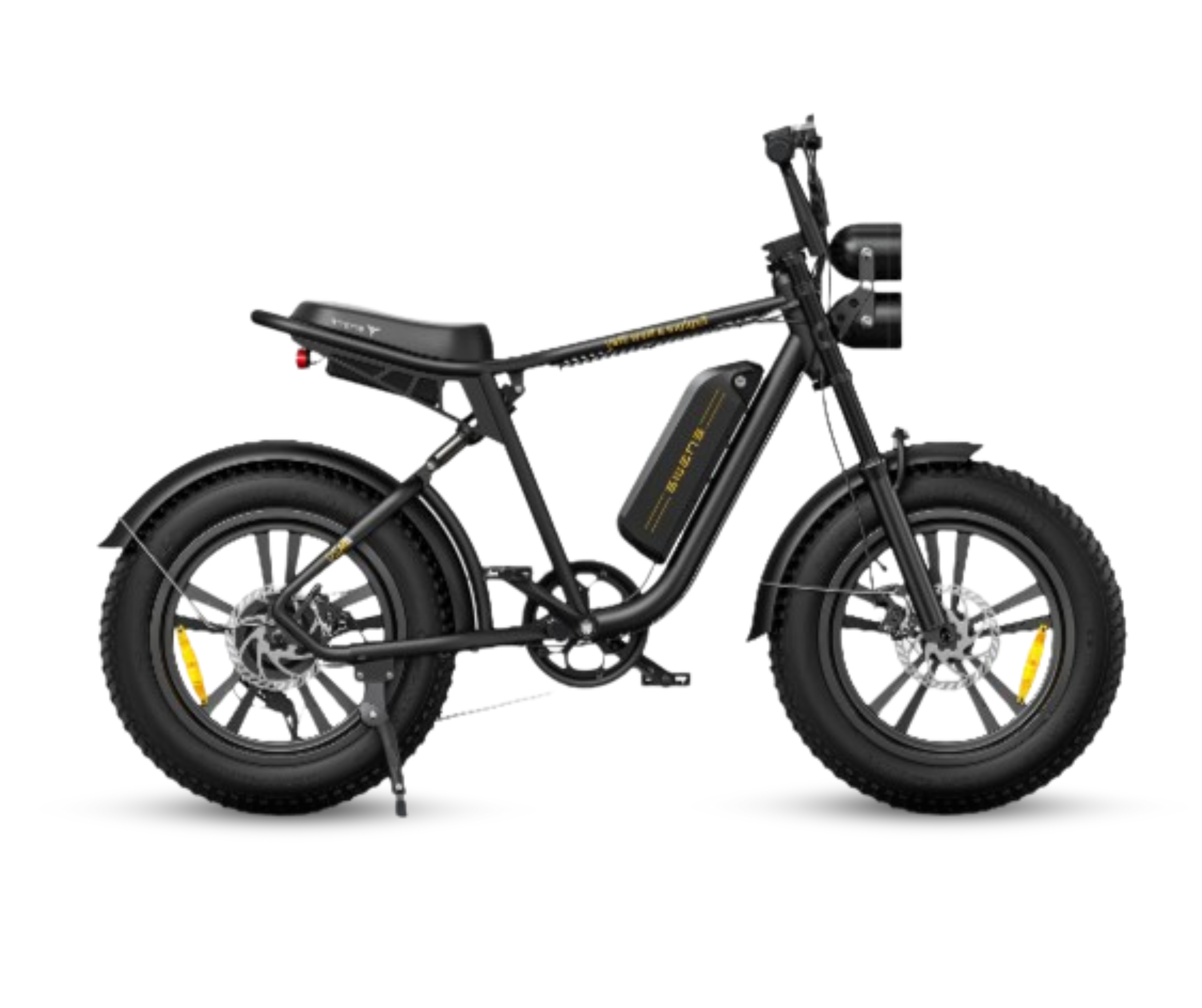

If you live in London, you've probably noticed it too. A protected bike lane appears on a road where there wasn't one. A junction gets redesigned with a dedicated cycle signal. A route you'd never have risked on two wheels suddenly has a kerb between you and the traffic. It happens quietly, street by street — but step back, and the scale of the change is remarkable.
London is doing, right now, what Amsterdam and Copenhagen started in the 1970s: deliberately rebuilding itself around the bike. In our last post, we looked at how the great cycling nations were built, not born. This is that same shift — happening on our own doorstep, faster than most people realise.
Here's the proof, the honest caveats, and why it matters for anyone thinking about riding in the capital.
Table of Contents
- The Numbers Are Genuinely Striking
- What You're Actually Seeing on the Streets
- The Cycling Boom Behind the Bike Lanes
- The Honest Caveats
- Why the E-Bike Is Perfect for This London
- The Folding Factor: Bikes, Trains & the TfL Rules
- How to Start Riding in London This Year
- FAQs
The Numbers Are Genuinely Striking
Let's start with the headline, because it's a big one. London's protected Cycleway network has just reached 450km in 2026 — and to put that in perspective, that's five times larger than it was in 2016, when there were just 90km of Cycleways. london
It's now so extensive that London's Cycleways stretch further than the capital's entire Tube network, and exceed the distance from London to Paris. Think about that: there is now more protected bike route in London than there is Underground. Fitzrovia News
And it's still accelerating. London's Cycleway network surpassed 400 kilometres in October 2024, with the next 50 kilometres arriving in under two years. The goal driving it all: Transport for London is working towards a target of having 40% of Londoners live within 400 metres of a Cycleway by 2030. Fitzrovia NewsFitzrovia News
This isn't a vague aspiration. It's steel, kerbs, and tarmac going into the ground, month after month.
What You're Actually Seeing on the Streets
If it feels like the lanes are multiplying around you, that's because they are. The most recent additions alone span Islington, Camden, Kingston, Westminster and Lambeth. Among them: Fitzrovia News
- A new 4km stretch in Islington connecting two existing Cycleways (Cycleway 1 and Cycleway 27). Fitzrovia News
- A 2.5km Cycleway in Camden improving links between Camden Town and King's Cross. Fitzrovia News
- A new 1.6km link connecting Wandsworth Common and Clapham Common. Fitzrovia News
- Cycleway 62 across Lambeth Bridge, and the first section of Cycleway 43 in Westminster between Hyde Park and Edgware Road. Fitzrovia News
And it's spreading beyond the centre. Outer boroughs are getting their turn, including the first-ever Cycleway in Harrow — a 4.5km route between Harrow and Pinner combining quieter back streets with segregated lanes on main roads. london
That's the bit that's easy to miss when you only see your own commute: this is a city-wide build-out, not just a central-London showpiece.
The Cycling Boom Behind the Bike Lanes
Infrastructure and ridership feed each other — safer routes bring out more riders, and more riders justify more routes. And the ridership numbers show the flywheel is spinning.
Cycling in London has risen an estimated 43% since 2016, with 1.5 million daily journeys taking place across the capital in 2025. To put that in everyday terms, London's daily cycle journeys are now equivalent to a sizeable fraction of Tube use — cycling has become genuine mass transport, not a fringe activity. london
Here's the most encouraging statistic of all, though. As cycling has surged, it's also got safer: the number of cycling fatalities fell from nine in 2024 to six in 2025 — the lowest level since 2020, and the second-lowest figure ever recorded. More people riding, fewer people hurt. That's exactly what good infrastructure is supposed to deliver, and it's the strongest possible argument that London is doing this right. Fitzrovia News
The Honest Caveats
We'd rather give you the real picture than a cheerleading one — so here's where London still falls short, because it genuinely does.
Progress is uneven. The network is a patchwork, and quality varies enormously between boroughs. A brilliant protected lane can still dump you onto a hostile junction at its end. If your particular route hasn't been touched yet, the "cycling revolution" can feel abstract.
Even TfL's own roads lag. A recent analysis found that only 13.6% of the 1,009km TfL Road Network has protected cycle track — and TfL built no new protected track on its own road network in the year to March 2025. Given those red routes carry around 30% of the capital's traffic, that's a real gap, and campaigners are right to push on it.
It's political and contested. Bike lanes, Low Traffic Neighbourhoods, and road-space reallocation remain genuinely divisive, and schemes can stall or reverse with political change.
None of this cancels the progress — 90km to 450km is transformational by any measure. But an honest picture is a more useful one: London is becoming a cycling city, not finished being one.
Why the E-Bike Is Perfect for This London
Here's where it gets interesting for anyone weighing up whether to ride. This new, safer, lane-connected London is almost tailor-made for the e-bike — and vice versa.
- Protected lanes remove the fear. The single biggest barrier to cycling in London has always been feeling unsafe in traffic. As protected Cycleways spread, that barrier falls — and an e-bike lets you keep pace confidently in the flow rather than being an obstacle.
- E-bikes shrink London. The capital is bigger and hillier than it looks (anyone who's cycled up from the river knows). An e-bike flattens the climbs and turns a "too far across town" trip into an easy, sweat-free ride.
- Faster than you'd think — and reliable. Across central London, a confident e-bike rider on connected lanes can genuinely rival the Tube door-to-door, without the delays, closures, or crowding.
- You arrive ready. Assist means you get to the meeting fresh, not flustered — the everyday-transport clincher.
As the lanes join up, the e-bike stops being a nice-to-have and becomes arguably the smartest way to move around inner London.
The Folding Factor: Bikes, Trains & the TfL Rules
One more London-specific point worth knowing, especially if your journey mixes cycling with rail.
Since 2025, non-folding e-bikes have been banned across most of the TfL network — the Tube, Overground, Elizabeth line and DLR — while folding e-bikes remain allowed. (We covered this fully in our train-rules guide.)
For Londoners, that makes a folding e-bike a particularly smart choice: ride the protected lanes for part of your journey, fold it, hop on the train for the rest, and unfold at the other end. It's the ultimate flexible-commute setup for a city that's simultaneously building bike lanes and restricting non-folding e-bikes on rail. A folder sidesteps the restriction entirely and makes the whole city yours.
How to Start Riding in London This Year
Tempted to make the most of the new London? A few practical steps:
- Plan a lane-connected route. Use the TfL Cycleways map to find protected routes near you — a journey that felt daunting on main roads is often calm and pleasant one street over.
- Choose the right bike. For most inner-London commutes, a nimble e-bike or a folding e-bike is ideal. Our first-time buyer's guide helps you choose.
- Sort security. Bike theft is real in London — a solid lock and ideally a tracker are essential. See our security guide.
- Gear up for the season. Lights, mudguards, and a waterproof make year-round London riding genuinely comfortable.
- Come and test-ride. The best way to find your London bike is to try it. Pop into a Uni-trax store and we'll help you choose.
Frequently Asked Questions
How big is London's cycle network now?
London's protected Cycleway network reached 450km in 2026 — five times its 2016 size of 90km, and now longer than the entire Tube network.
Is cycling in London actually growing?
Significantly — cycle journeys are up around 43% since 2016, with about 1.5 million daily journeys in 2025. Nearly a quarter of Londoners now cycle.
Is cycling in London safe?
It's getting safer as infrastructure improves — cycling fatalities fell to six in 2025, the second-lowest ever recorded, even as ridership rose. That said, quality varies by borough, so plan routes using protected Cycleways where you can.
Can I take my e-bike on the Tube?
Only if it's a folding e-bike. Non-folding e-bikes have been banned across most of the TfL network since 2025; folders remain allowed. See our full train-rules guide.
Is an e-bike a good idea in London specifically?
Very much so — e-bikes flatten London's hills, shrink its distances, help you keep pace safely on the new protected lanes, and can rival the Tube for door-to-door speed. A folding e-bike also sidesteps the TfL rail restrictions.
Where are the newest bike lanes?
Recent additions span Islington, Camden, Kingston, Westminster, Lambeth and beyond, with outer-borough routes like the first Cycleway in Harrow now arriving too. TfL's Cycleways map shows what's near you.
The Takeaway: You're Watching a City Change
It's easy to miss a transformation when it happens one bike lane at a time. But the numbers don't lie: London has gone from 90km to 450km of protected Cycleways in a decade, cycling is up 43%, and it's getting safer even as it grows. This is a city deliberately remaking itself around the bike — the same shift the Netherlands and Denmark made, unfolding on our own streets.
It's not finished, and it's not perfect. But if you've been waiting for London to feel ready for cycling, the honest answer is: it's getting there, fast — and there's never been a better moment to be part of it. The lanes are being built. The only question is whether you're on them.
▶ Explore our e-bikes at Uni-trax · Find your nearest London store for a free test ride.
Riding the new London? Show us your route on Instagram — we love seeing the city change one ride at a time.
▶ Subscribe to the newsletter for 10% off your entire order.
Article keywords
London cycling London bike lanes London Cycleway network cycling in London 2026 e-bike London commute is London good for cycling London cycling growth folding e-bike London Uni-trax London