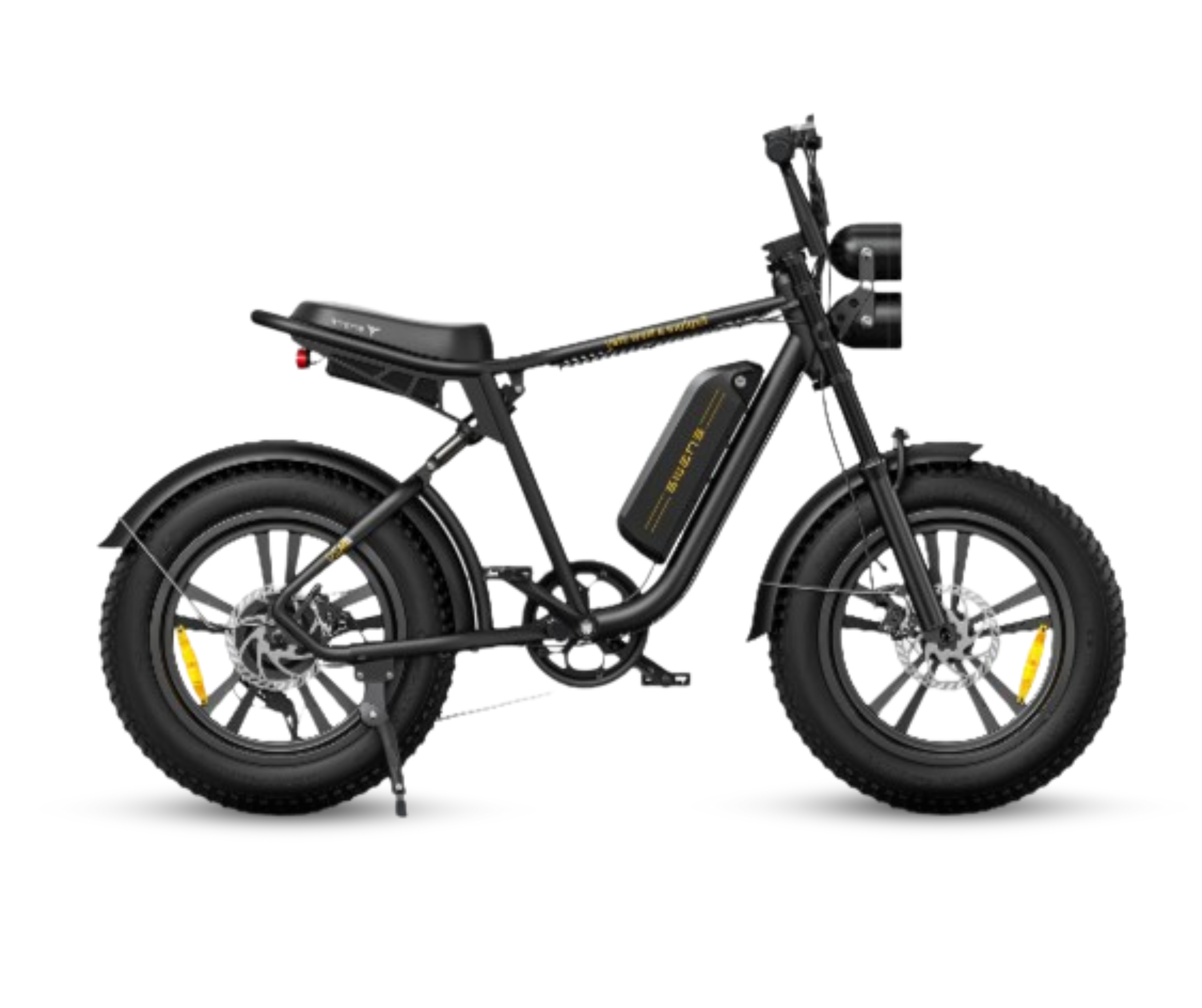

If ADO's story is about refinement, ENGWE's is about capability. Where some brands chase elegance, ENGWE has built its reputation on giving riders more — more torque, more range, more security, more versatility — and packing it into bikes that punch well above their price.
But "more power for less money" undersells what's actually going on. Behind ENGWE's range sits some genuinely clever engineering: mid-drive motors that flatten hills, patented folding systems, portable batteries that double as power banks, and smart IoT security built right into the frame. In this guide, we step back from the spec sheets and look at the bigger picture — the core technologies that define an ENGWE, how they've evolved, and what makes the brand tick.
Table of Contents
- ENGWE's Design Philosophy: Capability for Everyone
- The Big One: Mid-Drive Motors (and Why They Conquer Hills)
- Torque Sensors: The Natural-Ride Technology
- Battery & Charging Innovation
- Smart Security: The ENGWE IoT Module
- Portability Engineering: Folds, Weight & Power Banks
- Comfort & Capability: Suspension and Fat Tyres
- The Boost Button: Power on Demand
- What It All Means for You
- FAQs
ENGWE's Design Philosophy: Capability for Everyone
ENGWE's guiding idea is democratising capability — taking technology that used to be reserved for premium bikes (mid-drive motors, full suspension, GPS security, big-capacity batteries) and making it affordable and accessible.
That shows up as a few consistent priorities across the range: real power and hill-climbing ability, long range with fast charging, built-in smart security, and genuine versatility — folders, fat-tyre machines, commuters, and cargo bikes all under one badge. Crucially, ENGWE keeps its UK models within the 250W, 15.5 mph EAPC limit for road legality, so the engineering effort goes into delivering more capability within the rules — smarter torque delivery, better batteries, cleverer design — rather than simply chasing raw wattage. Let's look at the technologies that make that possible.
The Big One: Mid-Drive Motors (and Why They Conquer Hills)
ENGWE's flagship engineering story is its move into mid-drive motors — and understanding why is understanding the brand's ambition.
Most affordable e-bikes use a hub motor, mounted inside the wheel, pushing it directly. It's smooth, quiet, and cost-effective — ideal for flat-to-rolling terrain. But ENGWE's premium models (like the L20 3.0 Pro and N1 Pro) use a mid-drive motor mounted at the cranks, which is a genuine step up for one big reason: it drives the bike through the gears.
Here's why that matters, in plain terms. A hub motor produces a fixed output regardless of the gradient — it's working at maximum effort whether you're on flat tarmac or a steep climb. A mid-drive motor, because it spins through the bike's gears (e.g. a Shimano 7-speed), multiplies its effective torque through the gear ratio. Drop to a low gear on a climb and the mechanical advantage means the power reaching the wheel far exceeds the motor's nominal figure. That's why mid-drive bikes feel disproportionately powerful on hills relative to their wattage.
ENGWE's mid-drives make serious numbers: the Mivice X700 in the L20 3.0 Pro delivers a mighty 100 N·m of torque — genuine mountain-bike-grade pulling power that makes steep city inclines feel easy. And because the motor sits centrally and low, it also gives the bike better weight balance and handling.
The mid-drive technique worth knowing: because these motors work through the gears, the trick is to change down before a hill (not during it) and keep a smooth, steady pedal stroke — letting the torque sensor and gears do the heavy lifting. It's a small habit that makes a powerful bike feel effortless. (Our team will happily show you on a test ride.)
Torque Sensors: The Natural-Ride Technology
Whether hub or mid-drive, one technology defines how an ENGWE feels: the torque sensor.
Cheaper e-bikes often use a cadence sensor, which only detects whether the pedals are turning and delivers power in a somewhat abrupt on/off way. ENGWE uses a torque sensor, which measures how hard you're pressing and feeds the motor a proportional amount of assistance. Push harder and the power builds in a smooth, linear way; ease off and it tapers with you.
The result, in ENGWE's own words, is a seamless partnership between rider and machine — the assistance feels like an extension of your legs rather than a switch being flicked. It also improves efficiency (more range) and, importantly, delivers power predictably — which matters for control and grip, especially on loose or slippery surfaces. From the entry-level P20 and Zip to the flagship mid-drives, the torque sensor is a big part of why ENGWE bikes ride better than their price suggests.
Battery & Charging Innovation
Range and charging are areas where ENGWE genuinely pushes hard.
High-capacity cells. ENGWE equips its premium models with large, quality batteries — the L20 3.0 Pro and O20 Boost use 720Wh packs built from Samsung 21700 cells (among the best cylindrical cells available), delivering real-world range figures that reach up to 140–160 km depending on model and assist level.
Fast charging. This is a standout. The L20 3.0 Pro's 8A fast charger fills its 720Wh battery in around two hours — dramatically quicker than the 6–8 hours many e-bikes need. For anyone relying on their bike daily, cutting charge time by two-thirds is a genuinely meaningful upgrade.
Smart battery management. A quality BMS (Battery Management System) protects and optimises the pack — balancing charge, monitoring safety in real time, and extending battery lifespan (ENGWE cites strong capacity retention over hundreds of cycles).
And a clever twist — the portable power bank. On the Zip, ENGWE's battery lives in a carry bag and supports 100W USB-C charge and discharge (PD 3.0) — so it doubles as a power bank for your phone or laptop. A 20-minute top-up takes an iPhone from 0–50%. It's a genuinely original piece of thinking that blurs the line between transport and everyday tech.
Smart Security: The ENGWE IoT Module
This is one of ENGWE's most valuable technologies, and it's built right into the bike: the ENGWE IoT module.
On models like the L20 3.0 Pro, N1 Pro, and others, this integrated module combines GPS, 4G, and Bluetooth connectivity to deliver a full smart-security suite:
- Real-time GPS tracking — always know where your bike is, even if it's moved.
- Motion detection & instant alerts — get a phone notification the moment your bike is disturbed.
- Geo-fencing — set a safe zone and be alerted if the bike leaves it.
- App-based monitoring — check status, location, and ride data from your phone.
- On some models, a Smart Lock that auto-engages after a period of inactivity.
ENGWE is refreshingly honest that this supports theft prevention rather than replacing a physical lock — smart advice — but as a built-in layer of protection it's a feature usually found only on far more expensive bikes. It's a big part of ENGWE's "premium tech at an accessible price" story.
One thing to know: the smart/GPS features are typically free for the first year, then a small annual subscription (the 4G connectivity has an ongoing cost). Worth factoring in — but for the protection it offers, most owners find it well worth it.
Portability Engineering: Folds, Weight & Power Banks
ENGWE has put real engineering into portability, not just performance.
The standout is the Zip's patented triple-folding design, which uses a single-sided front fork to let the bike fold in around 3 seconds — genuinely quick, and unusual enough to be patented. Folded, it's roughly the footprint of a 20-inch suitcase, and at 16.9 kg it's light enough to carry up stairs and onto trains with ease.
Across the folding range, ENGWE engineers in one-hand folding, foldable stems and pedals, magnetic tyre holders (to lock the wheels together when folded), and clean integrated battery designs that keep the frame tidy. It's the kind of practical, everyday engineering that makes a bike genuinely liveable — the difference between a folder you can carry and one you actually want to.
Comfort & Capability: Suspension and Fat Tyres
ENGWE leans into comfort and all-terrain capability more than most brands at its price.
The headline here is the L20 3.0 Pro — the first compact folding e-bike with a genuine full-suspension system (a hydraulic front fork plus rear shock). ENGWE says this layup eliminates up to 90% of vibrations, delivering mountain-bike-grade smoothness in a folding, step-through frame — a genuine first-in-class piece of engineering.
Across the range, ENGWE also makes extensive use of fat tyres (typically 20" × 4.0") for grip, stability, and cushioning across sand, gravel, mud, and rough ground — and hydraulic disc brakes on its better models for strong, consistent stopping. Together, suspension and fat tyres are what make ENGWE bikes feel planted and confident where lighter bikes would rattle.
The Boost Button: Power on Demand
A neat ENGWE-specific touch worth highlighting: the Power Boost button, found on models like the L20 Boost, O20 Boost, and Engine Pro 3.0 Boost.
It's a clever solution to a real problem. UK law caps assisted speed at 15.5 mph, but hills sometimes need a surge of torque (not speed). The Boost button delivers a temporary burst of extra torque — up to 75 N·m on some models, 90 N·m on the Engine Pro 3.0 Boost — for quick acceleration and steep climbs, at the press of a thumb. Crucially, it only works while you're pedalling, so the bike stays road-legal. It's a smart, controlled way to unlock serious climbing power without stepping outside the rules — a nice example of ENGWE engineering within the legal limit rather than around it.
What It All Means for You
Strip away the spec sheets, and ENGWE's technology story comes down to one idea: premium capability, made accessible.
- The mid-drive motors mean genuine hill-flattening power.
- The torque sensors mean a smooth, natural ride.
- The big Samsung batteries and 8A fast charging mean long range with minimal downtime.
- The IoT module means built-in GPS security usually reserved for far pricier bikes.
- The folding and portability engineering means bikes you can actually live with.
- The full suspension, fat tyres, and Boost button mean comfort and capability across any terrain.
That's the real innovation behind ENGWE — not one headline feature, but a determined effort to give riders more of everything that matters, at a price that makes it genuinely attainable. It's engineering with a democratic streak, and it's why an ENGWE so often feels like more bike than you paid for.
Frequently Asked Questions
What makes ENGWE e-bikes different?
ENGWE focuses on delivering premium capability affordably — mid-drive motors, big Samsung batteries with fast charging, built-in GPS security, full suspension, and clever folding. You typically get features found on far pricier bikes, at an accessible price.
What is a mid-drive motor, and why does ENGWE use it?
A mid-drive motor sits at the cranks and drives the bike through its gears, multiplying torque for far better hill-climbing and a more natural feel than a hub motor. ENGWE uses Mivice mid-drives (up to 100 N·m) on premium models like the L20 3.0 Pro and N1 Pro.
How fast do ENGWE batteries charge?
Very fast on the premium models — the L20 3.0 Pro's 720Wh Samsung battery charges in around two hours via its 8A charger, far quicker than the typical 6–8 hours.
What is the ENGWE IoT module?
A built-in smart module combining GPS, 4G, and Bluetooth for real-time tracking, motion alerts, geo-fencing, and app monitoring — an integrated anti-theft layer. (It's usually free for year one, then a small annual subscription.)
Is the ENGWE Zip really foldable in 3 seconds?
Yes — its patented triple-folding design with a single-sided fork folds in around 3 seconds, and at 16.9 kg it's light enough to carry easily. Its battery even doubles as a 100W USB-C power bank.
Are ENGWE e-bikes UK road-legal?
The models we stock at Uni-trax are the 250W, 15.5 mph EAPC-legal versions — no licence, tax, or insurance needed. (ENGWE also makes higher-powered versions for other markets; always buy the UK-legal spec, which is what we sell.)
What's the Boost button?
A feature on models like the L20 Boost and Engine Pro 3.0 Boost that delivers a temporary surge of extra torque (up to 75–90 N·m) for hills and acceleration — while pedalling, so the bike stays road-legal.
Experience ENGWE's Technology for Yourself
Mid-drive climbing power, two-hour fast charging, built-in GPS security, a bike that folds in three seconds — these are the kinds of things you appreciate most when you actually ride them.
At Uni-trax, you can test-ride the ENGWE range at our UK stores, with honest, knowledgeable advice to help you find the right model for how you ride.
▶ Explore the ENGWE range at Uni-trax · Find your nearest store
Curious which ENGWE suits you best? Message us on Instagram or Facebook — we love talking tech and helping riders choose.
▶ Subscribe to the newsletter for 10% off your entire order.
Article keywords
ENGWE e-bike technology ENGWE mid-drive motor Mivice X700 ENGWE IoT GPS anti-theft ENGWE L20 3.0 Pro tech ENGWE fast charging ENGWE Zip folding torque sensor e-bike ENGWE Boost button ENGWE innovation