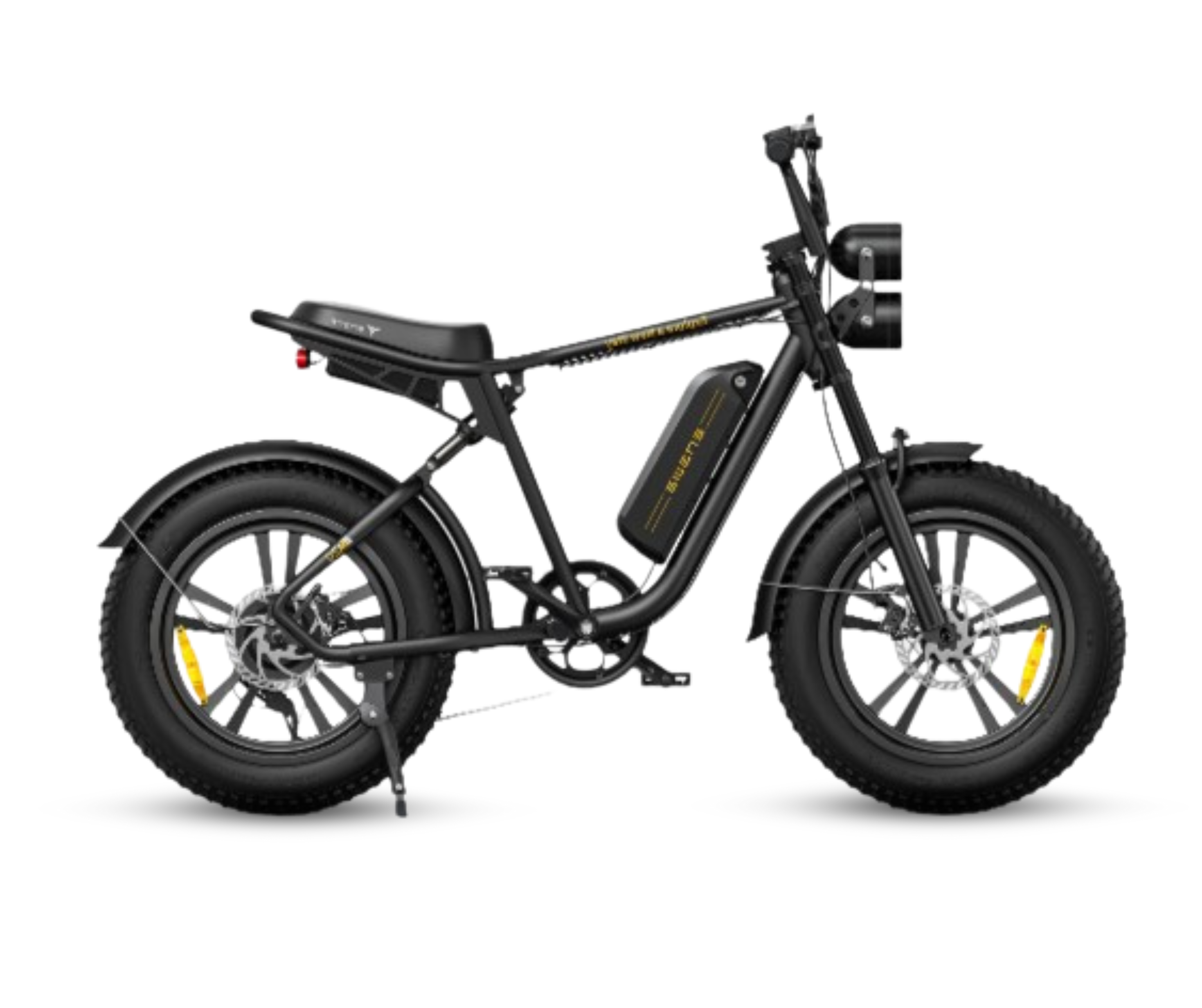

If you’ve seen Episode 1 of the Uni-trax Poodle Gang (available on our social media) — “The Last Bar” — you already know how this goes. If you haven’t, here’s the short version: Pierre is stuck on a gravel track in the rain with one flashing bar on his ADO Air Carbon Pro. He calls Margot, who turns out to be also down to one bar on her Fiido T3 Max, mid-croissant outside a bakery. Margot calls Bruno — who charged overnight, like a functioning adult — and he rides out on his ENGWE O20 Boost with a spare battery to rescue them both.
It’s a comic bit. It’s also, almost word for word, a conversation we have with customers every single week. So we figured it was worth writing down properly: why this keeps happening, and exactly how to stop it happening to you — with specifics for each of the three bikes in the story.
Why “I’ll charge it later” is the most common e-bike mistake
Nobody plans to get stranded. Pierre didn’t wake up intending to push a 13kg carbon frame through a field. The problem is that e-bike batteries don’t fail politely — they go from “fine” to “one flashing bar” faster than the fuel gauge on a car, especially in cold or wet weather, which saps lithium-ion capacity.
A few reasons this catches people out:
- Range estimates are best-case. Manufacturer range figures are usually measured on the lowest assist level, flat ground, warm weather, and a lighter rider than average. Real-world range in October drizzle can be 20–40% lower.
- Cold weather hits batteries hard. Lithium-ion chemistry loses usable capacity as temperature drops — noticeable from about 10°C and significant below freezing.
- “Charged yesterday” isn’t “charged.” Batteries self-discharge slowly even sitting idle. Bruno’s line — “Did you charge overnight?” / “...Define overnight” — is the whole problem in one exchange.
The fix isn’t complicated: charge before you ride, not after you notice the bar flashing. But how you charge and store each battery matters just as much as whether you do it, so here’s the breakdown per bike.
ADO Air Carbon Pro — Pierre’s bike
Pierre’s whole identity is “carbon fibre, thirteen kilos, zero electricity” — and that’s not far off the real spec sheet. The Air Carbon Pro runs a 37V 10Ah (370Wh) integrated battery, good for up to roughly 80km, charged with the included 42V 2A charger in about 4–6 hours.
Because the battery is built into the carbon frame rather than a removable pack, a few things matter more here than on other bikes:
- Charge indoors, at room temperature. An internal battery can’t be pulled out and charged somewhere warm and dry if you’ve left the bike in a shed — so don’t leave the whole bike out in the cold overnight if you can help it.
- Top up after every proper ride, not just when low. Since you can’t carry a spare battery as easily as on a cargo bike, there’s no “Bruno” coming to save you — plan your charge around your next ride, not around the warning light.
- Avoid letting it sit at 0%. A flat internal lithium battery left uncharged for weeks degrades faster than one topped up periodically, even in storage.
Fiido T3 Max — Margot’s bike
Margot’s T3 Max is the cargo bike of the group, with a 48V 13.5Ah (648Wh) standard battery (or up to 1620Wh combined on the dual-battery version), rated for up to 123km on a single pack.
Cargo bikes get used differently — shorter, heavier, more frequent trips — which changes the charging habits that matter:
- Charge after shorter trips too. Cargo riding (school run, shopping, hauling gear) drains batteries faster per mile than commuting, since you’re carrying more weight at lower speeds. Don’t assume a “short” trip means a trivial charge top-up.
- If you’ve got the dual-battery setup, charge both, not just one. It’s easy to plug in only the pack that looks emptier and assume you’re covered — that’s effectively what happened to Margot.
- Watch for croissant crumbs. (Only half joking — keep the battery contacts and port clean and dry, especially on a bike that spends time parked outside shops and cafés.)
ENGWE O20 Boost — Bruno’s bike
Bruno is the one who actually does this right, and his bike rewards it: a 48V 15Ah (720Wh) LG-cell battery with 75Nm of torque, charging in a fast 3.5 hours thanks to the included 4A charger, with up to 141km of range on the lowest assist setting.
A few reasons Bruno never ends up stranded:
- The fast charger is a genuine advantage — use it as a habit, not an emergency tool. A 3.5-hour full charge means there’s rarely an excuse to leave it overnight uncharged; plug it in as soon as you’re home, the same way you’d dock a phone.
- Keep a spare battery if you’re doing rescue-length or unpredictable mileage. Bruno’s spare pack is the reason the episode has a happy middle. The O20 Boost’s removable battery design makes this genuinely practical, unlike Pierre’s integrated pack.
- Fast charging generates more heat — let it charge somewhere ventilated, not inside a packed pannier or cupboard.
The rules that apply to all three bikes
Regardless of which Uni-trax bike you ride, the fundamentals are the same:
- Charge after every ride, not before the next one. Treat it like a phone, not a car — top-ups beat emergencies.
- Store between 20–80% for long gaps. If the bike’s sitting unused for more than a couple of weeks, a battery parked at full charge or completely flat ages faster than one left partially charged.
- Avoid extreme temperatures. Don’t charge a battery that’s freezing cold straight off a winter ride — let it come up to room temperature first. Don’t leave it baking in a car boot in summer either.
- Use the charger that came with the bike. Mismatched voltage or amperage chargers are the single most avoidable cause of battery damage and, in rare cases, fire risk.
- Check the battery before you leave, not when the display starts flashing. A five-second glance at the percentage before you head out the door would have saved Pierre, Margot, and genuinely a lot of our customers, a rainy phone call.
So, same time next week?
Bruno’s right, obviously — and Bruno’s also right that nobody’s going to listen. But at least now there’s no excuse: check the bar before you roll out, and if you ride an Air Carbon Pro, T3 Max, or O20 Boost, you’ve got the exact numbers above to work from.
Charge your bikes. Uni-trax.
Episode 2 — “Who Took the Fleet?” — coming soon.