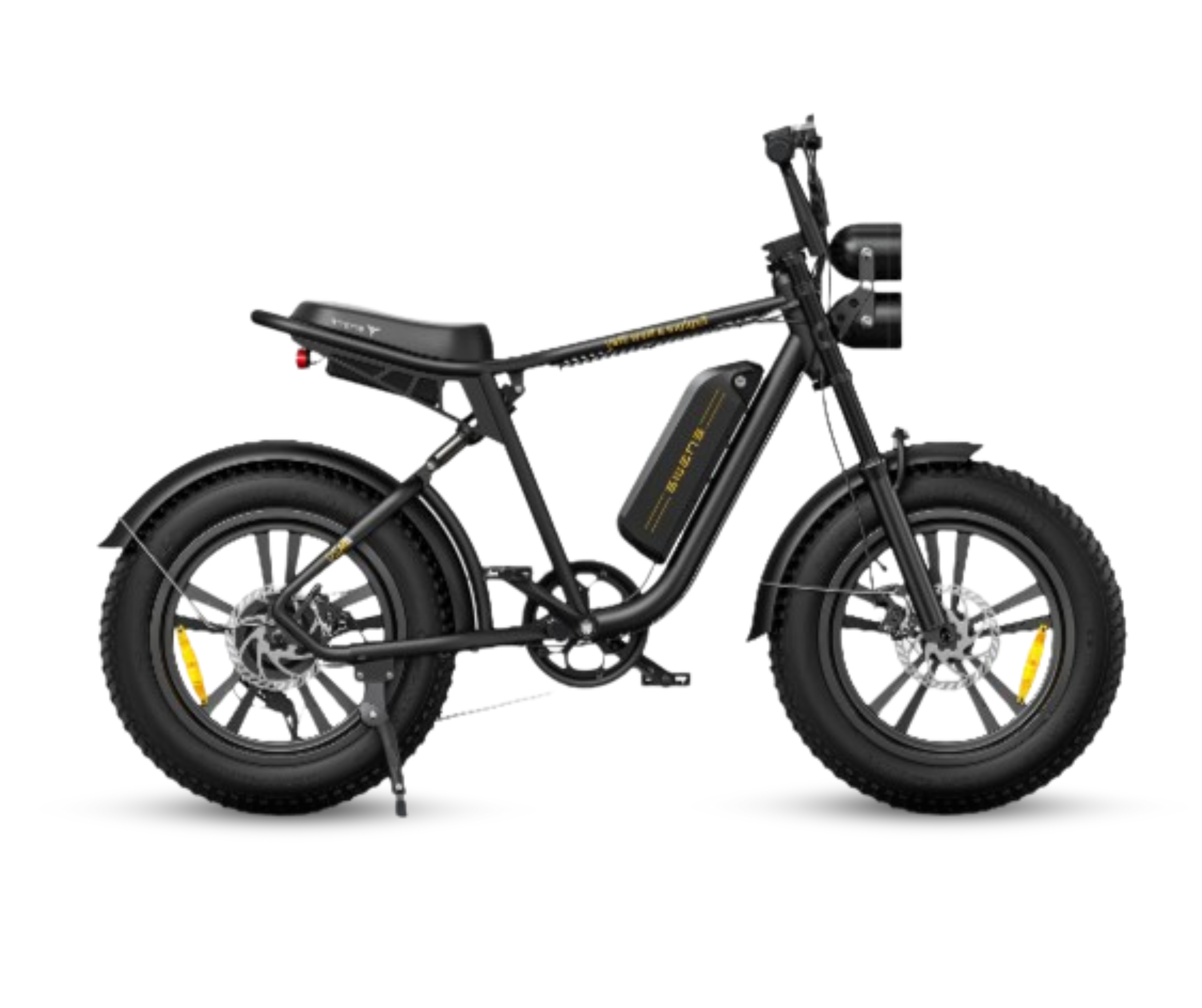

Scroll through the Emoko range and you'll notice these aren't your typical e-bikes. With their motorcycle styling, fat tyres, dual seats, and serious power, Emoko machines look and feel more like electric mopeds than pedal cycles — and that's exactly the appeal. They're bold, powerful, and genuinely fun.
But that power comes with an important responsibility: most Emoko models are not standard road-legal e-bikes under UK law, and it's essential to understand what that means before you buy. This isn't the exciting part of e-biking — but it's the honest, important part, and we'd rather you have the full picture than get an unpleasant surprise.
So here's a clear, straight-talking guide to what Emoko bikes are, how UK law treats them, and where you can legally ride one. No jargon, no small print — just the facts you need to buy and ride with confidence.
Table of Contents
- What Makes Emoko Different
- The UK Law: EAPC vs Motor Vehicle
- Why Most Emoko Bikes Aren't EAPCs
- Where You Can Legally Ride an Emoko
- What You'd Need to Make One Road-Legal
- So Who Is an Emoko For?
- Buying an Emoko the Right Way
- FAQs
What Makes Emoko Different
Emoko builds moped-style electric bikes — machines designed around motorcycle aesthetics and performance rather than the lightweight, pedal-first philosophy of a typical commuter e-bike. Depending on the model, that can mean:
- Powerful motors — well beyond the 250W of a standard e-bike, sometimes with two motors.
- Throttles and de-restrictable ("customisable") top speeds.
- Dual seats for carrying a passenger.
- Fat tyres, full suspension, and rugged, off-road-focused builds.
- Moped/motorcycle styling — they genuinely look the part.
These features are exactly what make Emoko bikes exciting. They're also, in most cases, exactly what takes them outside the legal definition of a normal e-bike in the UK. Here's why that matters.
The UK Law: EAPC vs Motor Vehicle
In the UK, electric two-wheelers fall into two very different legal categories.
1. EAPC (Electrically Assisted Pedal Cycle) — treated as a normal bicycle. To qualify, a bike must meet all of these:
- A motor of no more than 250W
- Motor assistance that cuts off at 15.5 mph (25 km/h)
- No throttle that propels it above 6 km/h without pedalling
- A single motor
- The rider must be at least 14
Meet all of those, and you need no licence, tax, insurance, or registration — you ride it like any bicycle.
2. Anything beyond that = a motor vehicle. If a bike exceeds 250W, has a throttle to full speed, uses dual motors, or can be de-restricted past 15.5 mph, it is legally a motorcycle or moped — not a bicycle. And that changes everything about how, and where, you can ride it.
This distinction isn't Emoko-specific or a Uni-trax rule — it's UK law, and it applies to every electric two-wheeler sold in the country.
Why Most Emoko Bikes Aren't EAPCs
Because of their design, most Emoko models fall into that second category — motor vehicles, not EAPCs. Take the range-topping example we can state precisely:
The Emoko C93 Dual Motor has two 75 N·m motors, a throttle, a customisable (de-restrictable) top speed, and dual passenger seating. A dual-motor machine doesn't meet the EAPC definition (which allows a single motor up to 250W), so it is legally a motor vehicle in the UK — it cannot be ridden on public roads, cycle paths, or bridleways without registration, licensing, insurance, tax, type approval, and an approved motorcycle helmet. It's built for private land and off-road use, and that's exactly how we describe it on its product page.
Other moped-style models in the range — the wider C93 family and the C94 — share these moped-style characteristics (throttles, higher power, passenger seating, or "customised" speeds) that generally place them outside EAPC rules too.
⚠️ The key point: Assume an Emoko is private-land / off-road only unless a specific model is clearly confirmed as fully EAPC-compliant (250W, single motor, 15.5 mph cut-off, no full-speed throttle). Always check the individual product page and ask us if you're unsure.
(Uni-trax note: confirm each model's exact spec before publishing — see my notes below. If any Emoko model genuinely meets all EAPC conditions, we can list it here as the road-legal option.)
Where You Can Legally Ride an Emoko
If a model is classed as a motor vehicle and isn't registered, here's the honest position:
✅ Where you can ride:
- Private land that you own, or where you have the landowner's explicit permission.
- Off-road private venues and designated private tracks.
- Regions or countries where such vehicles are road-legal (if you're riding abroad).
❌ Where you cannot ride (unregistered):
- Public roads
- Cycle paths and cycle lanes
- Bridleways and public byways
- Pavements, parks, and other public spaces
Riding an unregistered motor-vehicle-class e-bike in a public place is against the law and can lead to penalties, so it genuinely matters to keep these machines to private land unless you've gone through full registration.
What You'd Need to Make One Road-Legal
Could you make a moped-style Emoko legal for UK roads? In principle, a moped-class vehicle needs the full set:
- Type approval (the vehicle must be certified to the required standard)
- Registration with the DVLA (number plate)
- A driving licence valid for mopeds/motorcycles
- Insurance and road tax (VED)
- An approved motorcycle helmet
In practice, Emoko machines don't come with UK type approval, which is the foundational requirement — without it, the rest can't follow. That's why we're clear that these are, realistically, private-land vehicles in the UK rather than road bikes you can register. If road-legal riding is your goal, one of our EAPC-compliant e-bikes from ADO, Fiido, or ENGWE is the right choice instead.
So Who Is an Emoko For?
None of this is a reason not to buy an Emoko — it's simply about buying one for the right reason. An Emoko is brilliant if you:
- Have access to private land — a farm, smallholding, private estate, or land where you have permission to ride.
- Want off-road thrills — the power, fat tyres, and full suspension are genuinely fun on dirt, gravel, and trails.
- Love the moped-style look and feel — nothing else in our range has this attitude and presence.
- Understand and accept the legal position — you know it's private-land use, and that suits how you'll ride.
For that rider, an Emoko delivers power, presence, and off-road capability that a 250W EAPC simply can't match. It's a different kind of machine for a different kind of fun.
Not that rider? If you want something for commuting, cycle paths, or road use, we'll happily point you to a road-legal EAPC instead. We'd rather sell you the right bike than any bike.
Buying an Emoko the Right Way
If an Emoko is right for you, here's how to buy with total confidence:
- Read the product page carefully — each Emoko listing states its motor, speed, and legal status clearly. We don't hide it.
- Confirm you have somewhere legal to ride before you buy — private land or permission.
- Ask us anything — if you're unsure whether a model suits your situation, message us. We'll give you a straight answer, even if that answer is "this isn't the bike for you."
- Buy genuine and supported — every Emoko from Uni-trax is authentic stock with full support and warranty.
We sell Emoko because these machines are genuinely great fun for the right rider in the right place. We're just committed to making sure that's you, and that you know exactly what you're getting.
▶ Explore the Emoko range at Uni-trax — with the full, honest details on every model.
Frequently Asked Questions
Are Emoko e-bikes road-legal in the UK?
Most are not. Because of features like dual motors, throttles, higher power, and de-restrictable speeds, most Emoko models are legally motor vehicles, not EAPCs — meaning they can't be ridden on public roads or cycle paths without registration, licensing, insurance, and tax. They're intended for private land and off-road use. Always check the specific model's page.
Can I ride an Emoko on the road or cycle path?
Not if it's classed as a motor vehicle and isn't registered. That includes public roads, cycle paths, bridleways, and pavements. You can ride on private land, or land where you have the owner's permission.
Why isn't an Emoko a normal e-bike?
A UK road-legal e-bike (EAPC) must have a single motor of 250W or less, cut assistance at 15.5 mph, and have no full-speed throttle. Most Emoko models exceed one or more of these limits, which legally makes them mopeds/motorcycles rather than bicycles.
Can I register an Emoko for the road?
In practice, no — Emoko machines don't come with UK type approval, which is the essential first step for registration. They're best understood as private-land vehicles in the UK. For road use, choose an EAPC-compliant e-bike.
Do I need a licence or insurance for an Emoko?
To ride a motor-vehicle-class machine legally in public you'd need registration, a moped/motorcycle licence, insurance, tax, and a helmet. On private land with permission, these road requirements don't apply — but always confirm your local rules.
What's the difference between an Emoko and an ADO, Fiido, or ENGWE bike?
ADO, Fiido, and ENGWE bikes we sell as road bikes are EAPC-compliant — 250W, road-legal, no licence needed. Emoko machines are moped-style, higher-powered, and generally private-land only. Different tools for very different jobs.
Where can I get advice on which is right for me?
Just ask us — message us on Instagram or Facebook, or visit a store. Tell us how and where you'll ride, and we'll point you to the right machine, road-legal or off-road.
The Takeaway: Powerful Fun, With Eyes Open
Emoko machines are a genuinely exciting corner of our range — powerful, striking, off-road-capable, and unlike anything else we sell. But that power comes with a clear legal reality: most are moped-style motor vehicles, not road-legal e-bikes, and are intended for private land and off-road use.
Understand that, make sure you've got somewhere legal to ride, and an Emoko is enormous fun. Need something for the road or the commute instead? That's what our EAPC-compliant ADO, Fiido, and ENGWE bikes are for. Either way, we're here to make sure you ride the right machine — legally, safely, and with a big grin.
▶ Explore the Emoko range · See our road-legal e-bikes · Find your nearest store
Not sure which is right for you? Message us on Instagram or Facebook — we'll give you honest, straightforward advice.
Article keywords
Emoko e-bike UK are Emoko bikes road legal moped-style e-bike law UK Emoko C93 EAPC vs moped off-road electric bike UK private land e-bike electric moped UK law Uni-trax Emoko