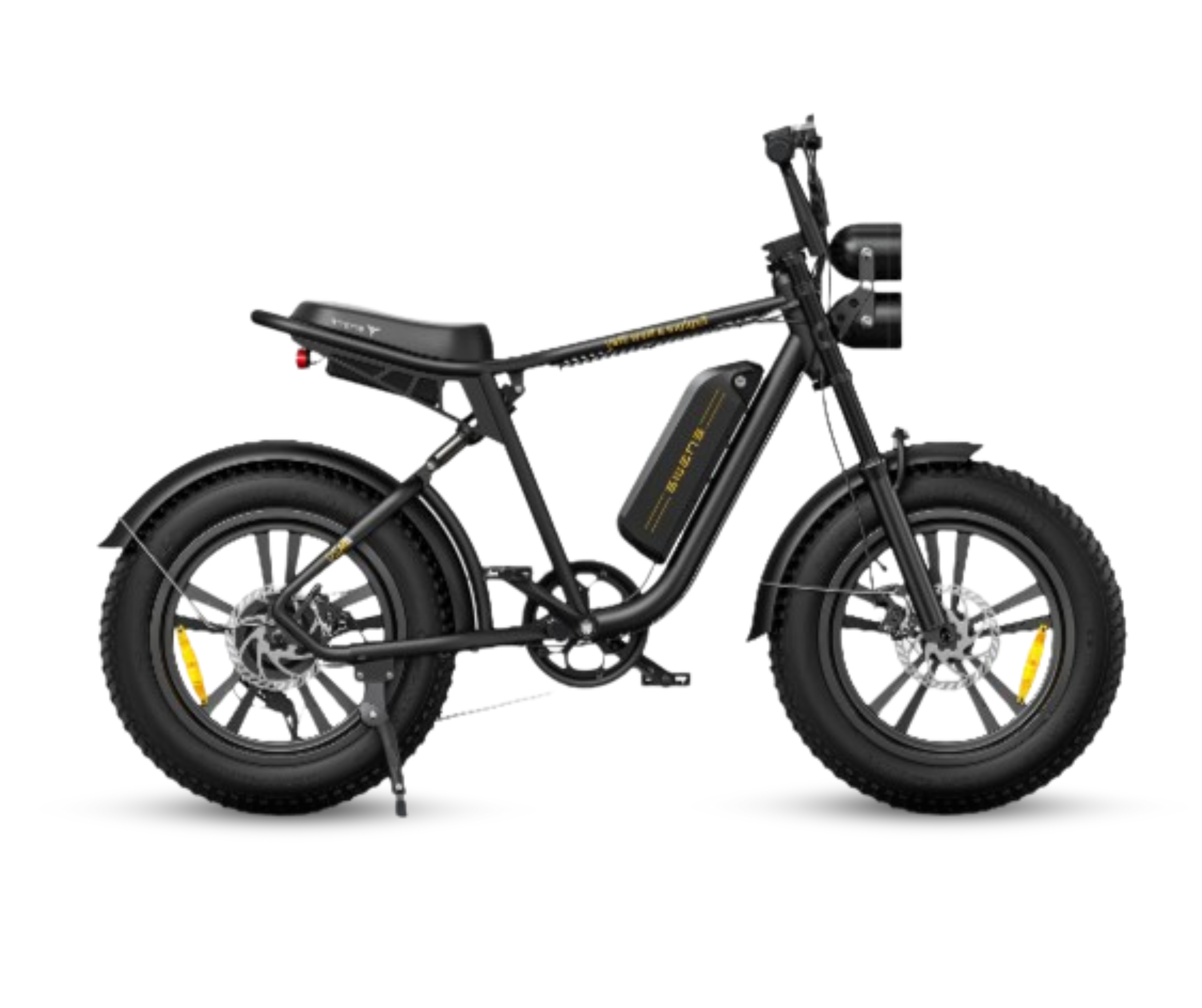

If you want a full-size ADO with automatic gears, you're choosing between two bikes that sit almost next to each other on price — and are built on completely opposite philosophies.
The Air 28 Pro starts at £1,299. The Air 30 Pro is £1,399. A hundred pounds between them.
And yet one folds down and goes on a train, while the other arrives with turn signals, GPS tracking and a rack bolted on. Same brand, same auto-shift idea, same £1,300-ish bracket — and almost nothing else in common.
So which hundred pounds is the right one to spend? Let's work it out properly.
The Pricing, First
| Model | Price | Was |
|---|---|---|
| Air 28 Pro | from £1,299 | £1,699 |
| Air 30 Pro (2-speed) | £1,399 | £1,799 |
| Air 30 Ultra (3-speed) | £1,499 | £1,799 |
All three are currently reduced, so the gaps are tighter than the RRPs suggest. The Air 30 comes in Cosmic Grey and Olive Green, in M and L frames.
The Headline Difference
The Air 28 Pro folds. The Air 30 doesn't.
For a lot of riders that settles it in one line. Folding decides whether the bike lives in a hallway or needs a shed, whether it fits a car boot, and — critically in London — whether you can take it on the Tube, Overground, Elizabeth line or DLR, where non-folding e-bikes have been banned since 2025.
If any of that is part of your life, stop reading and buy the Air 28 Pro.
If it genuinely isn't — if the bike lives in a garage and never sees a train — then the Air 30 starts looking like a lot of equipment for an extra hundred quid.
Side by Side
| Air 28 Pro | Air 30 Pro / Ultra | |
|---|---|---|
| Price | from £1,299 | £1,399 / £1,499 |
| Frame | Full-size folding | Step-over, non-folding |
| Motor | BAFANG H700, 2-speed auto | 250W integrated auto-shift in-wheel |
| Torque | 40 N·m | 40 N·m |
| Gears | 2-speed auto | 2-speed (Pro) / 3-speed (Ultra) |
| Battery | 36V/9.6Ah | 37V/10Ah, ultra-slim removable |
| Range | up to 100 km | up to 100 km |
| Drive | Carbon belt | Carbon belt |
| Brakes | Hydraulic disc | Hydraulic disc (front & rear) |
| Display | Colour | 3.5" IPS colour |
| Security | AirTag / SmartTag | Built-in anti-theft GPS |
| Lights | Integrated | Integrated + rear turn signals |
| Tyres | — | Anti-puncture |
| Rack & mudguards | Optional extra | Standard |
| Weight | Lighter (folding frame) | 26+ kg |
(Both are UK-legal 250W EAPCs with a 15.5 mph assist limit — no licence, tax or insurance.)
What the Extra £100 Actually Buys
This is where the Air 30 makes its case, and it's a stronger one than I expected.
Built-in anti-theft GPS. Not a tracker slot — real integrated GPS with live location and movement alerts, through the ADO Smart App. A decent aftermarket tracker costs £50–£100 on its own, so this alone eats most of the price difference.
Rear turn signals. Activated from the handlebars, which genuinely improves your safety at junctions — the moment you're most exposed is when you take a hand off the bars to signal. I can't think of another bike near this price that includes them.
Rack and mudguards as standard. On the Air 28 Pro these are accessories you'd likely buy. Add them up and the £100 gap closes to roughly nothing.
Anti-puncture tyres. Unglamorous, genuinely valuable on British urban roads.
A bigger, cleverer battery. 37V/10Ah in what ADO says is the slimmest integrated portable battery around — 448 × 51 × 52 mm — and it slides out sideways for indoor charging.
A 3.5" IPS colour display and seat-post shock absorption.
Priced individually — tracker, lights, rack, mudguards, tougher tyres — the Air 30's extra kit is worth considerably more than £100. On paper, it's the better-value bike.
The Catch: 26+ Kilograms
Here's the honest counterweight, and it's a big one.
The Air 30 weighs over 26 kg. That's a substantial bike. The Air 28 Pro, built as a folder, is meaningfully lighter.
Does it matter? It depends entirely on what happens when you stop riding:
- Rolling it into a garage or bike store? Barely matters. The motor does the work when you're moving.
- Carrying it up a single step? Noticeable.
- Getting it up a flight of stairs to a flat? Genuinely difficult, and not something you'll want to do daily.
- Lifting it into a car? Awkward on your own.
So the Air 30's equipment advantage comes with a real physical cost. It's a bike that wants to live at ground level and stay there. Suited to that life, it's excellent. Fighting against it, you'll resent the weight within a fortnight.
Pro or Ultra?
If the Air 30 is your bike, there's one more call — and at £100 it's an easy one.
The Pro has 2-speed automatic shifting at £1,399. The Ultra has 3-speed at £1,499.
A third automatic gear gives you a wider usable cadence range, which shows up most on hills and when accelerating from a stop. On flat city routes the Pro is perfectly sufficient — but if your commute has any gradient at all, the Ultra is worth the hundred.
ADO's own framing is that the Air 30's integrated in-wheel auto-shift motor — co-developed with BAFANG — hides the gearing entirely inside the hub, which is why the bike looks so clean with no exposed drivetrain.
So Which Should You Buy?
Buy the Air 28 Pro (from £1,299) if:
- ✅ You need to fold it — storage, car boot, or trains
- ✅ You're in London and use TfL
- ✅ You live up stairs, or lift the bike at all regularly
- ✅ You want the lightest bike of the two
- ✅ You don't need a rack, mudguards or GPS, or already have them
Buy the Air 30 Pro (£1,399) or Ultra (£1,499) if:
- ✅ The bike lives at ground level and stays there
- ✅ You want it fully equipped from day one — rack, mudguards, lights, tracker
- ✅ Turn signals and GPS security appeal to you
- ✅ You commute on roads where anti-puncture tyres earn their keep
- ✅ Take the Ultra if you have hills
My honest read: this is closer than the model numbers suggest. For £100, the Air 30 gives you several hundred pounds of equipment. But it asks you to give up folding and carry 26+ kg — and those two things together rule it out for a great many urban riders.
Ask yourself one question: where does the bike sleep, and do you ever need to lift it? Answer that and the choice makes itself.
Frequently Asked Questions
What's the difference between the ADO Air 28 Pro and the Air 30?
The Air 28 Pro folds; the Air 30 is a non-folding step-over city bike. Both use automatic shifting, carbon belt drives and hydraulic brakes. The Air 30 adds built-in GPS, rear turn signals, a rack, mudguards, anti-puncture tyres, a 3.5" IPS display and a larger battery — for £100 more, but at over 26 kg.
Which is better value?
On equipment, the Air 30 — the GPS alone is worth most of the £100 gap, before you count the rack, mudguards and lights. On practicality, the Air 28 Pro, because folding and lower weight open up storage and travel options the Air 30 can't match.
Can I take either on the Tube?
Only the Air 28 Pro. Non-folding e-bikes have been banned across most of the TfL network since 2025.
What's the difference between the Air 30 Pro and Air 30 Ultra?
The Pro has 2-speed automatic shifting (£1,399); the Ultra has 3-speed (£1,499). The Ultra suits hillier routes.
How heavy is the Air 30?
Over 26 kg. It's a fully-equipped bike with a rack, mudguards and integrated lighting, so that's the real-world figure — plan for it if stairs are involved.
How far will they really go?
Both claim up to 100 km in ideal conditions. Expect roughly 60–70% of that in real UK riding, depending on terrain, rider weight and assist level.
Do both have removable batteries?
Yes. The Air 30's slides out from the side — handy for charging indoors in winter.
The Verdict
Two bikes, £100 apart, built for opposite lives.
The Air 28 Pro is the flexible one. It folds, it's lighter, it's cheaper, and it goes places a full-size bike legally can't. For flat-dwellers, train commuters and anyone who lifts a bike, it isn't a close contest.
The Air 30 is the equipped one. GPS, turn signals, rack, mudguards, anti-puncture tyres and a bigger battery for a hundred pounds more is genuinely good value — as long as you've got somewhere to keep 26 kg of bike at ground level.
Neither is the better bike in the abstract. One of them is clearly better for you.
▶ See the ADO Air 28 Pro — from £1,299 · See the ADO Air 30 — from £1,399 · Find your nearest store for a free test ride.
Still weighing it up? Message us on Instagram or Facebook — tell us where the bike will live and we'll give you a straight answer.
▶ Subscribe to the newsletter for 10% off your entire order.
Keywords: ADO Air 28 Pro vs Air 30 ADO Air 30 review ADO Air 30 Pro Ultra folding vs city e-bike e-bike with turn signals ADO auto shift best ADO commuter